Gulyás, Pörkölt and Paprikás: What Sets Them Apart, and Where to Eat Each in Budapest
On this page
- The three dishes
- What to expect at the table
- Gulyás
- Pörkölt and the szaft
- Paprikás and nokedli
- Pickles on the side
- Good to know when you order
- Erős Pista and the heat
- Bread is part of the meal
- Service charge and tipping
- What a plate costs in October 2026
- Where to eat them
- 1. Rosenstein Vendéglő: family cooking with Jewish-Hungarian roots
- 2. Gettó Gulyás: a pörkölt kitchen in the Jewish Quarter
- 3. Stand25 Bisztró: the classics, bistro-style
- 4. Frici Papa Kifőzdéje: homestyle cooking at friendly prices
- Local habits worth borrowing
- 1. Fröccs with a heavy meal
- 2. The napi menü
- 3. Buying paprika to take home
- A few things to plan for
- The short version
Gulyás is a soup, pörkölt is a stew with no flour in it, and paprikás is the creamy one finished with sour cream. Those three words cover most of what a Hungarian kitchen does with paprika, and once you know them, every menu in Budapest reads more easily.
Outside Hungary, “goulash” usually means a thick stew over noodles. In Budapest that dish is pörkölt, and gulyás is the soup the herdsmen cooked in a single cauldron. This guide explains what separates the three, what they cost right now at four kitchens we like, and how to get the most out of the meal.
The three dishes
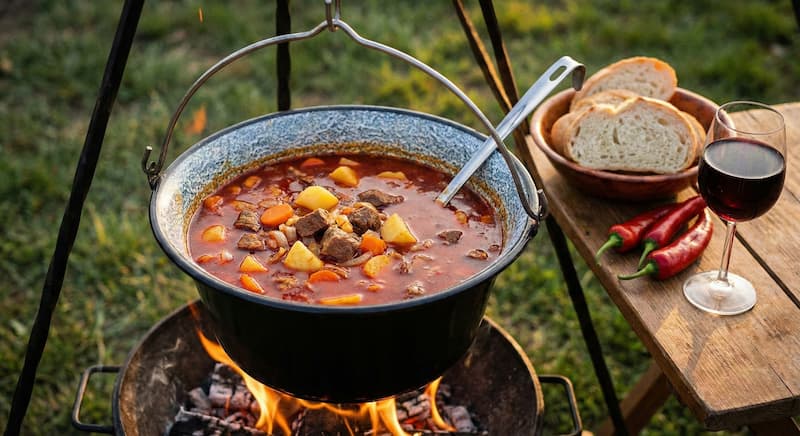
1. Gulyás (the soup). Gulyás is a soup: rich and hearty, but a broth. It comes from the herdsmen (gulyás) of the Great Hungarian Plain, who cooked it in one cauldron over an open fire. It holds beef, potatoes, carrots, parsnips and csipetke, small pinched pieces of pasta. The surface shines with red drops of paprika-colored fat, and caraway gives it its warm background note.
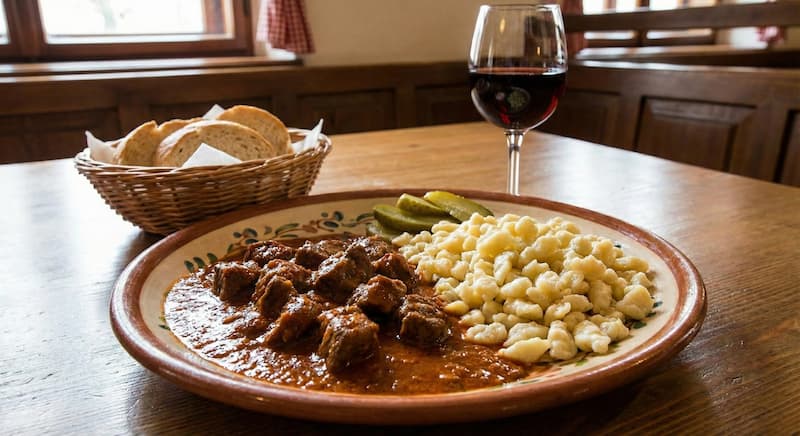
2. Pörkölt (the stew). This is what most of the world calls goulash. Pörkölt is boneless meat (beef, pork, chicken, game, or rooster testicles for the curious) cooked with a generous amount of onion. The thick sauce, the szaft, gets its body from onions cooked down slowly and from the meat itself, not from flour. It rarely contains vegetables beyond onions and peppers, and it is usually served with nokedli or tarhonya.
3. Paprikás (the creamy one). Paprikás starts from the same onion, paprika and fat base as pörkölt and is finished with sour cream (tejföl), often with a little flour, into a silky orange sauce. Chicken and veal are the classics, catfish paprikás is the river version, and nearly every plate comes with nokedli egg dumplings. It is the comfort food of a Hungarian childhood.

What to expect at the table
Gulyás
A proper gulyás arrives in a deep bowl, sometimes in a small enamel cauldron. The beef, usually shank or shoulder, is tender enough to fall apart, and the broth is savory rather than thick. Heat is optional and added at the table. Break off a piece of crusty white bread, dip, and repeat.
Pörkölt and the szaft
Ordering a marhapörkölt (beef pörkölt) brings a plate that is mostly meat and sauce. The magic is the szaft, the dark, concentrated sauce from onions cooked down in fat until they melt into the meat juices and paprika. Gettó Gulyás calls itself a pörkölt kitchen and cooks ten to fifteen kinds every day, from beef and game to kakashere, rooster testicle and comb pörkölt, which is milder and creamier than its reputation.
Paprikás and nokedli
Csirkepaprikás (chicken paprikás) is the bright, orange opposite of dark pörkölt, and bone-in chicken legs give the most flavor. Nokedli (also written galuska on menus) are soft, irregular egg dumplings made by pushing a wet dough through a grater into boiling water. They are there to carry the sauce.
Pickles on the side
Rich stews call for something sour, and Hungarian menus list pickles (savanyúság) separately:
- Kovászos uborka: cucumbers fermented with bread and dill in summer, cloudy, sour and lively.
- Csalamádé: a pickled mix of sliced cabbage, peppers, onions and cucumber, crisp and tart.
- Ecetes almapaprika: round yellow apple peppers pickled in vinegar, which can carry a surprising bit of heat.
At Gettó Gulyás a portion of kovászos uborka is 1,100 Ft and a mixed pickle plate 2,150 Ft.
Good to know when you order
Erős Pista and the heat
Hungarian food is not inherently hot. Cooking paprika is mostly sweet (édes) or delicate (csemege): it brings color and flavor rather than fire. Heat is added at the table.
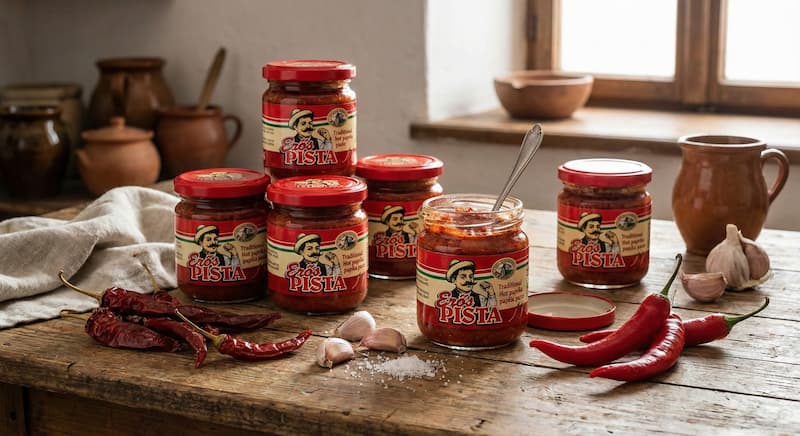
The small jar of red paste on many tables is Erős Pista (“Strong Steve”), minced hot paprika preserved with salt. Taste your soup or stew first, then stir in a little at a time, and leave the salt shaker alone if you plan to use it. Some kitchens offer fresh hot peppers (hegyes erős) instead, which add heat without extra salt.
Bread is part of the meal
With pörkölt or gulyás, the bread basket is a tool. Tunkolni, wiping up the last of the sauce with bread, is how locals finish the plate, and in a homestyle kifőzde you will see plates wiped clean.
Service charge and tipping
Many Budapest restaurants add a service charge (szervizdíj), and it must be shown on the menu and the bill. If it is there, it is the tip. At the four places below, Gettó Gulyás adds 12%, Rosenstein 10%, and Stand25 adds a service charge to food and drink. Where there is no service charge, 10 to 15 percent is usual. Our tipping guide has the details.
What a plate costs in October 2026
| Kitchen | Dish | Price (HUF) | About (USD) |
|---|---|---|---|
| Gettó Gulyás | Alföld-style gulyás soup with sourdough bread | 3,090 | ~9.50 |
| Gettó Gulyás | Free-range chicken paprikás with egg nokedli | 4,490 | ~14 |
| Gettó Gulyás | Red-wine beef pörkölt with house tarhonya | 4,690 | ~14.50 |
| Frici Papa Kifőzdéje | Gulyás soup | 3,599 | ~11 |
| Frici Papa Kifőzdéje | Red-wine beef pörkölt (nokedli +459) | 3,999 | ~12.50 |
| Frici Papa Kifőzdéje | Paprikás chicken breast (nokedli +459) | 3,799 | ~11.50 |
| Rosenstein | Alföld-style gulyás, served in a cup | 3,500 | ~10.50 |
| Rosenstein | Catfish paprikás with túrós csusza | 6,800 | ~21 |
| Rosenstein | Red-wine game pörkölt with sheep’s cheese galuska | 6,500 | ~20 |
| Stand25 Bisztró | Gulyás | 5,900 | ~18 |
| Stand25 Bisztró | Wild boar cheek pörkölt with butter galuska | 9,900 | ~30.50 |
| Stand25 Bisztró | Three-course Stand25 menu (gulyás and boar cheek pörkölt among the choices) | 19,500 | ~60 |
Prices are in HUF, which is what you pay at the table. Converted at 1 USD = 326 HUF, the ECB rate on 9 October 2026. Rates move, so treat the converted figures as indicative. Sources: Gettó Gulyás menu, Frici Papa menu, Rosenstein menu, Stand25; prices and hours checked 11 October 2026.
A gulyás soup runs from 3,090 to 5,900 Ft across these four, and a main of pörkölt or paprikás from about 4,000 to 9,900 Ft. For a sit-down comparison with more addresses, see our guide to the best goulash in Budapest.
Where to eat them
1. Rosenstein Vendéglő: family cooking with Jewish-Hungarian roots
What is it? A family restaurant on Mosonyi utca 3 in District VIII, near Keleti station, run by the Rosenstein family, father to son. Its cooking blends Hungarian and Jewish-Hungarian flavors, and the menu comes in several languages.
Why it’s worth it: for the breadth of the classics done with care. Catfish paprikás with túrós csusza (6,800 Ft), red-wine game pörkölt with sheep’s cheese galuska (6,500 Ft) and Alföld-style gulyás in a cup (3,500 Ft) sit on one menu, next to Jewish eggs (4,500 Ft) and goose cracklings (5,550 Ft) to start. It suits a long lunch or dinner with family or friends. Plan around Sunday: the restaurant opens Monday to Saturday.
Insider tip: the weekly specials follow a fixed rhythm: sour lung stew with bread dumplings on Tuesday, stuffed cabbage on Wednesday and tripe pörkölt on Thursday, at 4,950 Ft each. Six private rooms make it a good choice for a group, and our kosher and Jewish food guide has more on the house.
The facts: Mosonyi utca 3, Monday to Saturday 12:00 to 23:00. Book a table online through the restaurant’s website. A 10% service charge is added.
2. Gettó Gulyás: a pörkölt kitchen in the Jewish Quarter
What is it? A stew house on Wesselényi utca 18 in District VII, in the former Szóda Bár, with Zsolnay plates, solid wooden tables, old jugs and candlelight. Chef Kristóf Nagy keeps ten to fifteen pörkölts going every day.
Why it’s worth it: the range of pörkölt is the twist: red-wine beef with house tarhonya (4,690 Ft), juniper and porcini venison with bread dumplings (5,790 Ft), rooster testicle and comb pörkölt with sourdough bread and pickles (4,590 Ft), and a textbook chicken paprikás with egg nokedli (4,490 Ft). It suits first-timers who want to taste several classics and locals who want a good pörkölt in the center. The room fills up in the evening, so book ahead for dinner.
Insider tip: leave room for túrógombóc with cinnamon sour cream (2,590 Ft); our Hungarian desserts guide explains why. Children can order anything with anything, for example tarhonya with sauce.
The facts: Wesselényi utca 18, open daily 12:00 to 23:00, table booking online. A 12% service charge is added.
3. Stand25 Bisztró: the classics, bistro-style
What is it? Szabina Szulló and Tamás Széll’s bistro at Attila út 10 on the Buda side, a walk from the Chain Bridge and the Castle Tunnel. It earned a Bib Gourmand barely a year after opening, and gulyás and somlói are its signature dishes.
Why it’s worth it: this is where traditional cooking meets fine-dining technique without losing its soul. Gulyás (5,900 Ft), wild boar cheek pörkölt with house butter galuska (9,900 Ft) and catfish paprikás with sheep’s cheese sztrapacska (9,900 Ft) are on the classics list. It suits a special lunch or dinner. It costs more than a homestyle kitchen, and the bill carries a service charge.
Insider tip: the three-course Stand25 menu (19,500 Ft) lets you start with gulyás, follow with the boar cheek pörkölt and finish with any dessert from the menu. Dogs are welcome, and street parking around Roham and Pauler utca is free at weekends.
The facts: Attila út 10, District I. Monday to Saturday, lunch 12:00 to 16:00 (last arrival 14:30), dinner 17:30 to midnight (last arrival 21:30), closed Sunday. Book online or by phone on +36 30 961 3262.
4. Frici Papa Kifőzdéje: homestyle cooking at friendly prices
What is it? A kifőzde, a homestyle lunch-and-dinner kitchen, on Király utca 55 in District VII, open since spring 1997. Its own motto is “good food, cheap, in a nice place”, and it serves grandmother-style cooking from a menu that changes daily.
Why it’s worth it: for value. Gulyás soup is 3,599 Ft, red-wine beef pörkölt 3,999 Ft and paprikás chicken breast 3,799 Ft, with nokedli for 459 Ft, and the daily specials board adds dishes such as chicken thigh pörkölt. It suits students, budget travelers and anyone who wants an everyday Budapest meal. Plan around Sunday, when the kitchen is closed.
Insider tip: check the daily specials on the Frici Papa website before you go; that is where the cheapest pörkölt of the day appears. Desserts include somlói galuska and mákos guba at 1,999 Ft.
The facts: Király utca 55, Monday to Saturday 11:00 to 22:00, eat in or take away.
If you would rather have someone else pick the stops, a guided food tour or a set traditional dinner covers several of these dishes in one evening.
Local habits worth borrowing
1. Fröccs with a heavy meal
Beer works, but the classic Hungarian pairing for a rich stew is fröccs, wine mixed with soda water. The bubbles refresh the palate between bites, and every ratio has its own name:
- Kisfröccs (small): 1 dl wine + 1 dl soda
- Nagyfröccs (large): 2 dl wine + 1 dl soda
- Hosszúlépés (long step): 1 dl wine + 2 dl soda, the summer favorite
- Házmester (caretaker): 3 dl wine + 2 dl soda
- Viceházmester (vice-caretaker): 2 dl wine + 3 dl soda
- Sportfröccs: 1 dl wine + 4 dl soda
Use a decent everyday wine and szikvíz, soda water from a siphon, if you mix it yourself.
2. The napi menü
On weekdays many restaurants offer a napi menü (daily menu) at lunchtime: a soup and a main, sometimes a dessert, for a fixed price. It is often where főzelék (vegetable stews) and other everyday dishes appear. Look for a board outside or ask “Van napi menü?”
3. Buying paprika to take home
For cooking paprika, go to the Great Market Hall or a neighborhood market rather than a souvenir shop.
- Look for Kalocsa or Szeged paprika.
- Édes (sweet) is the standard cooking paprika, csemege (delicate) is mild and sweet, csípős is hot, and füstölt is smoked. Traditional dishes use unsmoked sweet paprika.
- Paprika loses color and flavor with light and air, so buy tins rather than clear bags and store them in the dark.
A few things to plan for
Hearty food. These dishes lean on lard, red meat, onions and dumplings. A gulyás followed by pörkölt and a dessert is a big meal, so a walk along the Danube afterwards is a good plan.
Salt. Between Erős Pista and the stew base, traditional meals can be salty. Taste before you season and keep water on the table.
Service style. Traditional Hungarian service tends to be direct and efficient rather than chatty. That is the local baseline, not a sign that anything is wrong.
Vegetarians. The traditional section of a menu is mostly meat, but there are good options: Gettó Gulyás has forest mushroom pörkölt with nokedli (4,390 Ft), vegan lecsó (3,990 Ft) and vegan stuffed peppers (4,490 Ft), and Frici Papa serves gombapaprikás (2,999 Ft). Even vegetable dishes such as rakott krumpli (layered potatoes) can contain sausage, so ask “Van benne hús?” (Is there meat in it?).
The short version
Gulyás tells the story of the herdsmen and their one-pot meal. Pörkölt is village cooking built on onions, fat and patience. Paprikás adds sour cream for something gentler, good enough for Sunday lunch.
Budapest serves all three, from a 3,599 Ft gulyás at a homestyle kifőzde to a Bib Gourmand bistro’s boar cheek pörkölt. Know which is the soup, taste before you add Erős Pista, order a fröccs, and enjoy the bread.
Good to know
Is gulyás gluten-free?
Traditional gulyás soup and pörkölt get their body from onions and meat rather than flour, but paprikás is often thickened with flour, and nokedli and csipetke are made with wheat flour. Ask the kitchen; menus such as Rosenstein's mark dishes that are gluten-free without the dumplings.
Can I drink the tap water in Budapest?
Yes, Budapest tap water is safe to drink. In restaurants, a request for water usually brings bottled mineral water, so ask for csapvíz if you want tap water.
What is the difference between nokedli and galuska?
Menus use both words for the small egg dumplings served with paprikás and pörkölt. Csipetke is different: small pinched pieces of dough cooked in gulyás soup.
Do I need to tip if there is a service charge?
No. If the bill shows szervizdíj, the service is already paid. Gettó Gulyás adds 12%, Rosenstein 10%, and Stand25 adds a service charge to food and drink. Where there is none, 10 to 15 percent is the usual tip.
Where can I eat a vegetarian version?
Gettó Gulyás has a forest mushroom pörkölt with nokedli (4,390 Ft), a vegan lecsó (3,990 Ft) and vegan stuffed peppers (4,490 Ft). Frici Papa serves gombapaprikás, a mushroom paprikás, for 2,999 Ft.
Book it, skip the counter


Prices checked 2026-10-12. Booking through these links supports the site at no extra cost to you. How this works.